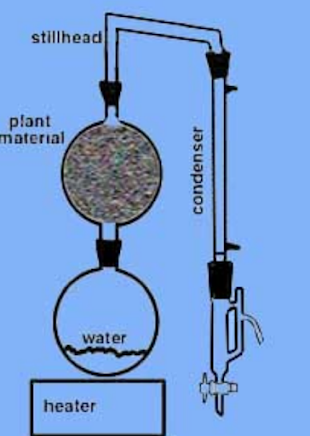
Steam distillation is carried out by passing dry steam through the plant material whereby the steam volatile compounds are volatilized, condensed and collected in receivers.
Steam distillation is a separation process used to purify or isolate temperature-sensitive materials. In steam distillation, dry steam is passed through the plant material. These vapors undergo condensation and collection in receivers.
The process of steam distillation separates the substances of a mixture through evaporation, which then involves condensing the vapor back into liquid, taking advantage of the fact that different elements or compounds have different boiling points. It is a method for separating miscible liquid base depending upon their volatilities.
Steam distillation is a widely utilized method for extraction of volatile constituents, especially in the case of using leaves and flowers as starting materials. Steam distillation is used for the isolation of antioxidant and antimicrobial compounds from herbs and species such as clove, rosemary, sage and thyme.
It has been in use for essential oil extraction for many years. Steam distillation are widely used in the manufacturing of essential oils, for instance perfumes. This method uses a plant material that consists of essential oils.
The advantage of steam distillation over simple distillation is that the lower boiling point reduces decomposition of temperature-sensitive compounds. Steam distillation is useful for the purification of organic compounds, although vacuum distillation is more common.
Extraction method - Steam distillation
The primary goal of food is to promote our health and general well-being. Food science entails comprehending the characteristics, composition, and behaviors of food constituents in different situations, such as storage, handling, and consumption.
Showing posts with label extraction methods. Show all posts
March 21, 2022
July 23, 2014
Plant oils extraction
Most plant or vegetable oils are obtained from beans or seeds, which generally furnish two valuable commodities: a fatty oil and a protein-rich meal.
The most common vegetables oils used in food preparation come primarily from soybeans, rapeseed, sunflower seed, corn, cotton seed, and safflower seeds.
Depending on the products oil extraction ranges from simple, inexpensive, small scale techniques o complex capital-intensive methods. The oils are usually removed from plant tissues by three methods.
In the first method, cells containing oil are ruptured by heat and mechanical methods. To maximize extraction efficiency, oil seeds are usually ‘crushed’ thus decreasing particle size and lowering the mass transfer resistance of oil removal.
A second method is called expeller method. This method involves squeezing the seeds at very high pressures, which may generate some heat. The oil still retains most of their flavor, color, aroma and nutrients.
The third method involves solvent extraction using petroleum hydrocarbons at 60 – 70 degree Celsius. Solvent extraction is a more recent method. This method, which is a continuous one, has a capacity of processing of hundreds of tons of oil per day.
The by-products of these methods are proteins, which are used in animal feeds.
Seed extraction is achieved by pressing and/or extraction with hexane. Oils such as palm and olive, on the other hand, are pressed out of the soft fruit or endosperm.
Expeller methods are typically used for edible products such as nutrients and food oils, whereas solvent extraction is for more modern oil application.
Plant oils extraction
The most common vegetables oils used in food preparation come primarily from soybeans, rapeseed, sunflower seed, corn, cotton seed, and safflower seeds.
Depending on the products oil extraction ranges from simple, inexpensive, small scale techniques o complex capital-intensive methods. The oils are usually removed from plant tissues by three methods.
In the first method, cells containing oil are ruptured by heat and mechanical methods. To maximize extraction efficiency, oil seeds are usually ‘crushed’ thus decreasing particle size and lowering the mass transfer resistance of oil removal.
A second method is called expeller method. This method involves squeezing the seeds at very high pressures, which may generate some heat. The oil still retains most of their flavor, color, aroma and nutrients.
The third method involves solvent extraction using petroleum hydrocarbons at 60 – 70 degree Celsius. Solvent extraction is a more recent method. This method, which is a continuous one, has a capacity of processing of hundreds of tons of oil per day.
The by-products of these methods are proteins, which are used in animal feeds.
Seed extraction is achieved by pressing and/or extraction with hexane. Oils such as palm and olive, on the other hand, are pressed out of the soft fruit or endosperm.
Expeller methods are typically used for edible products such as nutrients and food oils, whereas solvent extraction is for more modern oil application.
Plant oils extraction
April 16, 2008
Crude Fat
Crude fat is the term used to refer to the crude mixture of fat-soluble material present in a sample. Crude fat also known as the ether extract or the free lipid content, is the traditional measure of fat in food products.
The lipid materials may include triglycerides, diglycerides, monoglycerides, phospholipids, steroids, free fatty acids, fat soluble vitamins, carotene pigments, chlorophylls, etc.
The common approach for total crude fat determination is based on the solubility of lipids in non-polar organic solvents such as hexanes, petroleum ether, or supercritical liquid carbon dioxide with or without a solvent modifier.
The two methods most commonly used to determine crude fat are wet extraction and dry extraction. Wet extraction is performed with the water remaining in the sample.
The Babcock method and the Mojonnier method both are wet extraction methods used for crude fat determinations in milk and milk products. These methods have also been applied to other products such as raw, canned, and frozen fish.
The Babcock method is one which releases the fat from the milk emulsion and measures the percentage directly in bottles calibrated for this.
The Babcock method does not determine the phospholipids in the milk products. It is not applicable to products containing chocolate or added sugar without modification of charring of chocolate and sugars by sulfuric acid.
A common dry extraction method is Soxhlet extraction method is performed with anhydrous ether. It is common crude fat determination method in many food. This technique extracts the crude fat into ether which is finally evaporated. Dry extraction is preferred when it is inconvenient to remove most of the water from a food. After extraction the solvent is evaporated, the residue weighed and reported as percent crude fat.
Three factors that affect crude fat analysis are moisture content, sample preparation, and extraction methodologies.
Crude Fat
The lipid materials may include triglycerides, diglycerides, monoglycerides, phospholipids, steroids, free fatty acids, fat soluble vitamins, carotene pigments, chlorophylls, etc.
The common approach for total crude fat determination is based on the solubility of lipids in non-polar organic solvents such as hexanes, petroleum ether, or supercritical liquid carbon dioxide with or without a solvent modifier.
The two methods most commonly used to determine crude fat are wet extraction and dry extraction. Wet extraction is performed with the water remaining in the sample.
The Babcock method and the Mojonnier method both are wet extraction methods used for crude fat determinations in milk and milk products. These methods have also been applied to other products such as raw, canned, and frozen fish.
The Babcock method is one which releases the fat from the milk emulsion and measures the percentage directly in bottles calibrated for this.
The Babcock method does not determine the phospholipids in the milk products. It is not applicable to products containing chocolate or added sugar without modification of charring of chocolate and sugars by sulfuric acid.
A common dry extraction method is Soxhlet extraction method is performed with anhydrous ether. It is common crude fat determination method in many food. This technique extracts the crude fat into ether which is finally evaporated. Dry extraction is preferred when it is inconvenient to remove most of the water from a food. After extraction the solvent is evaporated, the residue weighed and reported as percent crude fat.
Three factors that affect crude fat analysis are moisture content, sample preparation, and extraction methodologies.
Crude Fat
Subscribe to:
Posts (Atom)
The Most Popular Posts
-
Theophylline in Natural Sources: Stimulant and Health Benefits in Cocoa, Tea, Guarana, and Kola NutsTheophylline is naturally present in cocoa beans, with Criollo cocoa beans containing up to 3.7 mg/g, making them a significant source of th...
-
Crude fat refers to the crude mixture of fat-soluble material present in a sample, encompassing a range of lipid materials including triglyc...
-
Gelatinization occurs when starch granules are heated in a liquid. It is responsible for the thickening of food systems. The process is an i...
-
Crude fiber is a measure of the quantity of indigestible cellulose, pentosans, lignin, and other components of this type in present foods. ...
-
Crude fat is the term used to refer to the crude mixture of fat-soluble material present in a sample. Crude fat also known as the ether ext...
