Showing posts with label terpenes. Show all posts

March 17, 2023

Terpenoids - organic chemicals derived from the 5-carbon compound isoprene

The terpenoid are called Isoprenoids are a large and diverse class of naturally occurring organic chemical. Terpenoid is an oxygen-containing terpenes (alcohols, ketones, aldehydes)

The name "terpene" is derived from the word "turpentine“. Terpenes and terpenoids are the primary constituents of the essential oils of many types of plants and flowers.

Most of the terpenoids are colorless, fragrant liquids which are lighter than water and volatile with steam. A few of them are solids e.g. camphor. All are soluble in organic solvent and usually insoluble in water. Most of them are optically active.

Terpenoids are universally present in small amount in living organism where they a numerous role in plant physiology as well as important function in all cellular membrane. They are the main constituent of essential oils of plants and flower.

Most natural terpenoids hydrocarbon have the general formula (C5H8)n. They can be classified on the basis of value of n or number of carbon atoms present in the structure. Classification of terpenoids (and example)
*Hemiterpenes - Prenol, isovalericacid
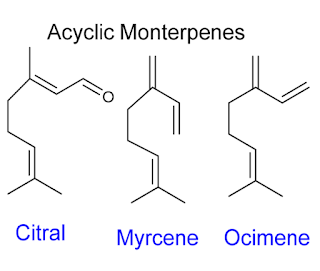
*Monoterpenes - geraniol, limonene, terpineol
*Sesquiterpenes - humulene, farnesenes, farnesol
*Diterpenes - cafestol, kahweol, cembrene, taxadiene, retinol, retinal, phytol
*Sesterterpenes - Geranylfarnesol
*Triterpenes - Squalene
*Tetraterpenes - lycopene,alpha-,beta-and gamma-carotenes
*Polyterpenes

The simpler mono and sesqui terpenes are chief constituent of the essential oils obtained from sap and tissues of certain plants and trees.

Monoterpenoids are a major class of compounds in essential oils. Monoterpenoid in plants: attracting pollinator (e.g. insect) to flowers, protection from herbivores and microbial infection

And monoterpenoids in insect: defence and pheromonal secretion.
Terpenoids - organic chemicals derived from the 5-carbon compound isoprene

December 12, 2021

Terpenes

The term terpene, proposed by Dumas in 1866, originates from the Latin word ‘turpentine’ (Balsamum terebinthinae), a liquid extract from pine trees. Turpentine contains the "resin acids" and some hydrocarbons, which were originally referred to as terpenes. Traditionally, all natural compounds built up from isoprene subunits and for the most part originating from plants are denoted as terpenes.

Terpenes are the largest and most diverse group of plant secondary compounds and basically consist of five carbon isoprene units which are assembled to each other (many isoprene units) by thousands of ways. These compounds are classified as to the number of isoprene units, which include the hemiterpenes (1), monoterpenes (2), sesquiterpenes (3), diterpenes (4), sesterterpenes (5), triterpenes (6) and polyterpenes (many units).
Terpenes are common in most plants and fungi, but they rarely accumulate in bacteria. The development of chromatographic and spectroscopic methodologies in 1945 propelled the explosive discovery of terpenoids and terpene-derived products. Terpenoidal molecules are antifungal, antimicrobial, antiviral, and antiparasitic.

Many flavorings and nice fragrances are consisting on terpenes because of its nice aroma. Conifer wood, balm trees, citrus fruits, coriander, eucalyptus, lavender, lemon grass, lilies, carnation, caraway, peppermint species, roses, rosemary, sage, thyme, violet and many other plants or parts of those (roots, rhizomes, stems, leaves, blossoms, fruits, seed) are well known to smell pleasantly, to taste spicy, or to exhibit specific pharmacological activities due to terpenes compound.

Some terpenes have high vapor content and are therefore classified as volatile (VTs), e.g., hemiterpenes, monoterpenes, and sesquiterpenes. Others are semi-volatile or non-volatile, such as diterpenes.
Terpenes

The Most Popular Posts